| |
|

History
In the 1840s in the hills of Shropshire, England, progressive sheep breeders began to cross the native black-faced sheep with improved Southdown, Leicester, and Cotswold sheep to develop a medium sized, dual- purpose breed that became known as Shropshires. The popularity of the Shropshire breed rose dramatically and in 1859 the Royal Agricultural Society recognized them as a distinct breed.
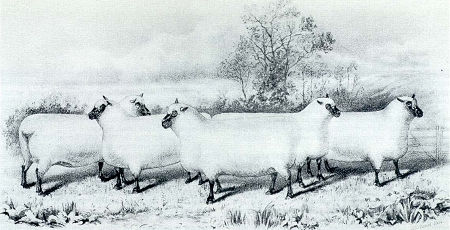
Five English Shearling Ewes - Bred by Joseph Beach
First Prize, R.A.S.E., Shrewsbury, 1884
Shropshires were first imported in 1855 into the United States and in 1884 the American Shropshire Registry was founded. During the period of 1880s to the 1930s Shropshires were the most popular and influential breed in the United States. There was even a period of time when this country had more registered Shropshires than all other breeds combined. In the late 1930s and 1940s Shropshire breeders followed a fad and bred for compact wool-blind sheep. Their prestigious position was lost.
During the 1950s a few progressive breeders thought that the Shropshire needed to return to the characteristics that earlier made them so popular. These breeders imported a select group of rams from England to breed larger, more purposeful animals with open faces. Over the last few decades, Shropshires have evolved into a very modern and productive breed, perfect for families with youth projects. Today the Shropshire breed has continued to establish itself as a leader in the industry by becoming the first black faced, slick sheared breed.
|
Shropshire Benefits
Extremely feed efficient
Prolific mothers
High rates of gain
Meaty carcasses
Easy lambers
Medium sized
Multiple births
Longevity
Shown slick sheared
Great youth projects |
The naming of Shropshire sheep
There have been inquiries for a little while regarding the naming of Shropshire sheep. After some investigation, the ASRA Board of Directors has voted to begin allowing breeders to officially name their sheep. People usually want to name special rams but ewes will be allowed to be christened, also. Now, it is true that some breeders name all of their rams and a few breeders name every sheep they register. Breeders will be able to continue to do this as they desire. If they wish to reserve a certain name for an important individual, however, they will be required to pay a fee of $25 to the ASRA. This will entitle them to be the sole user of that name for a 10-year period. The secretary will keep track of the names purchased and will publish a list of reserved names in each issue of the Voice.
For example, there are now several ewes in the database with the name of “Princess”. Any person registering sheep may name any or all of their ewes “Princess” until a breeder pays the $25 fee and reserves that name for a specifi c sheep, either at the time of registration or some time afterward. Once that name is reserved, it may not be used again for 10 years, either as an informal name or a reserved name.
This opportunity for breeders became available on January 1, 2012. Names should be submitted in writing, either on the registration application at the time of registration or by written request submitted with an existing registration certifi cate in which case a new certifi cate with the sheep’s christened name will be issued. It is still recommended that a farm or fl ock name be used and a number matching a tag or tattoo in the sheep’s ear is required. No sheep will be officially named without payment the $25 fee. Questions regarding this opportunity can be directed to the registry office.
Articles
Cody Hiemke of Wisconsin received some old paperwork from Bill and Susan Shultz that belonged to Bill's father. These are items he had collected over the years. One is a booklet, "History of Shropshire Sheep by Alfred Mansell, 1913" and another two page typed article by J. Gibson Whittles, published in "The Field" in 1950.
Video
Cody Hiemke of Wisconsin shared this link of a 24 minute “SHEEP” video from 1954 that Texaco Oil Company put together. The Shropshire section starts at 11 minutes 30 seconds into the video. At 12:10 in the video an imported Shropshire ram is shown.
Cody reported that Bill Shultz thought the ram was either Sir Winston or Tern Cambridge, who his father, Farrell Shultz, imported back then. Based on photos of Tern Cambridge Cody also believes it was him.
"He was an impressive ram! Very cool to see a video of a sheep from back then!" said Cody.
Bill confirmed to Cody that the filming took place at their farm in Ohio. "Farrell must have herded the sheep into our front yard at Bunker Hill which still looks very much the same today," Bill said.
|
|